
A New View on Life: Patient Grateful for the Gift of Sight

Watching Broadway musicals holds special meaning for Rosalie Rhodes after receiving the gift of sight through organ donation.
The 77-year-old retired probation officer recently underwent a corneal transplant. Now, Rhodes and her sister enjoy theater performances together near Rutherford, New Jersey.
“We saw ‘Jersey Boys.’ It was wonderful for me to see, to hear it,” she said. “I’m able to walk and go up and down the stairs and to walk down the aisle. I’m grateful that these things are happening, and I’m able to do it.”
Bell’s Palsy Leads to Left Eye Corneal Damage
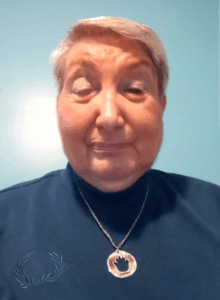 Diagnosed a year ago with Bell’s palsy, Rhodes experienced paralysis or weakness on the left side of her face. The neurological disorder made closing her left eyelid difficult. This led to exposure keratitis, a condition where the cornea dries out. The cornea is the transparent, dome-shaped outer layer of the eye that bends light and helps you focus.
A specialist sewed her left eye closed to allow it to heal, but her vision did not improve. Rhodes’ condition worsened and eventually resulted in vision loss.
“My vision was so impaired,” Rhodes said. “They decided that I needed a corneal transplant.”
Rhodes was referred to ophthalmologist Joseph A. DeLuca, MD, FACS, for evaluation.
“She developed an ulcer of the cornea inside the eye because she could not close her eyelid,” Dr. DeLuca said. “They treated the ulcer until she was healed, but that left a scar. It left neovascularization of the cornea. Her sight was compromised a great deal.”
Corneal neovascularization is the abnormal growth of blood vessels in the cornea. In some cases, this condition can result in corneal swelling and vision loss.
“[Rhodes] could have left it alone, and then the vision would have just been what it was, but she was motivated,” Dr. DeLuca said. “She chose to have a corneal transplant.”
Organ Transplant Restores Patient’s Vision
Doctors perform more than 40,000 corneal transplants annually in the U.S. Corneal transplant surgery, or keratoplasty, replaces a damaged or diseased cornea with healthy corneal tissue from an organ donor.
After several weeks, the Lions Eye Bank for Long Island notified Dr. DeLuca’s office about a potential corneal tissue donor. A 24-year-old man had passed away, and his family opted for organ donation.
“He wasn’t 70 years old or 50 years old; he was 24,” Rhodes said. “I am so grateful to the parents; they were so incredibly wonderful to do this.”
The next day, Rhodes underwent a penetrating keratoplasty (PK) at an AMSURG ambulatory surgery center (ASC). During this procedure, Dr. DeLuca removed her damaged cornea then sewed a clear donor cornea into place.
More than 97 percent of corneal transplants successfully restore the recipient patient’s vision. Rhodes returned a day later for a post-op exam with Dr. DeLuca.
“I could see! That was the first thing,” Rhodes said. “I was able to see color … I can see letters if they’re dark and on a light background. I will never have vision like I had prior to all of this, but it is a thousand percent better than I anticipated.”
Patient Enjoys Independence, Improved Quality of Life
Full vision recovery for corneal transplant recipients can take up to a year for some patients.
“The patient has to agree that when you do a full thickness [corneal] transplant, there’s a lot of post-operative care,” Dr. DeLuca said.
Currently, Rhodes administers daily eye drops to treat dry eye, a condition where the eyes do not produce enough tears. Dry eye is a common temporary side effect after a corneal transplant.
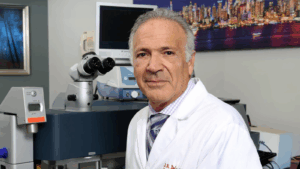 Considering the complexity of her case, Dr. DeLuca is pleased with Rhodes’ overall recovery.
“She’s a grand slam. She’s not wearing glasses, and she’s 20/25 after full thickness keratoplasty. Just exceptional,” he said. “It just went flawlessly, really.”
Through her gift of sight, Rhodes now manages grocery shopping without assistance and reads books with clear vision.
“I was able to do food shopping by myself. I walked the entire length and width of the store twice,” she said. “Now, I’m able to read — something I hadn’t been able to do in a long, long time.”
Rhodes said she appreciates Dr. DeLuca’s expertise and professionalism to restore her vision.
“I am so grateful to him and God,” she said. “I had God on my shoulder, and so did he.”
To express her heart-felt appreciation for the organ donation, Rhodes wrote a letter to the family thanking them. She submitted the letter to the eye bank for delivery.
“They gave me a chance to see out of that eye. I can’t thank them enough,” Rhodes said. “My heart goes out to them for their loss.”
Consider Eye Surgery at an Ambulatory Surgery Center
 Ambulatory surgery centers offer same-day, high-quality procedures with the most advanced technologies available. ASCs provide significantly lower costs than other facilities for the same procedure. Patients then recover at home.
Rhodes praised the ASC staff and clinical and surgical team for their work during her corneal transplant.
“They were so wonderful before the surgery, during [and] after,” she said.
May Is Healthy Vision Month. Schedule Your Eye Exam.
During May — Healthy Vision Month — focus on protecting and preserving the health of your eyes. Schedule comprehensive eye exams for you and your family before problems arise. Your eye doctor will evaluate your current eye prescription and check your visual acuity. They will screen you for eye conditions like cataracts, glaucoma and macular degeneration.
Have you met your health insurance deductible already? If you need surgery, like cataract surgery or a corneal transplant, schedule it at our ASC before the year ends. This way, you can make the most of your health plan’s benefits. Prioritize your eye health; call today to make an appointment.
This article is designed for educational purposes only. The information provided should not be used for diagnosing or treating a health concern or disease. It is not a substitute for professional care. If you have or suspect you may have a health concern, you should consult your healthcare provider.